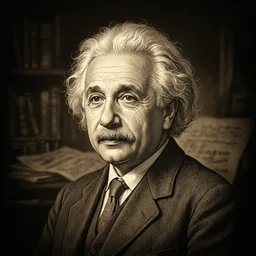

Meet Albert Einstein: The Clerk Who Rewrote Physics
MentorMinds
Read aloud by an AI voice
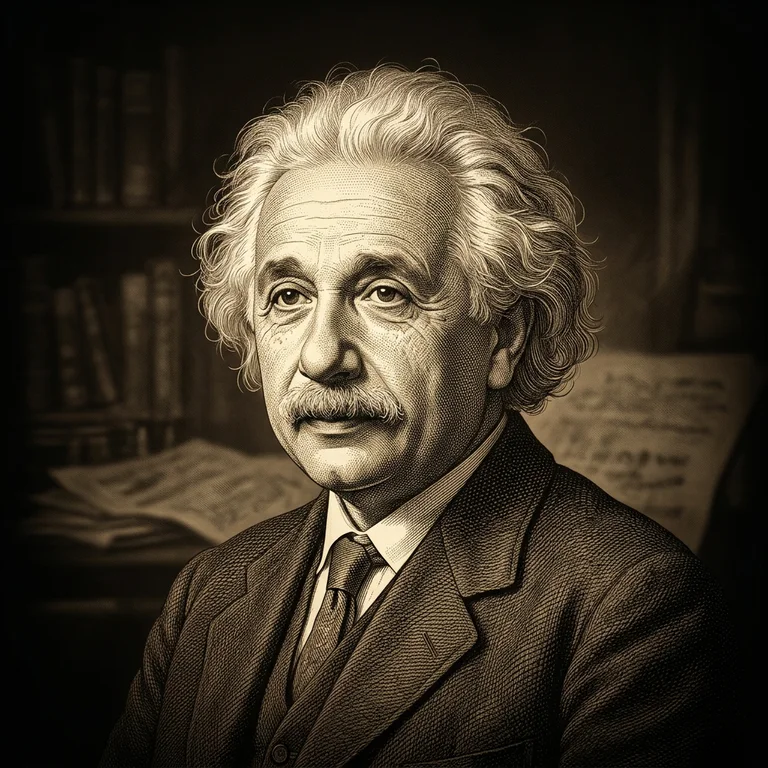
The patent office
He could not get an academic post. From 1902 he worked as a technical examiner in the Swiss patent office in Bern, assessing other people's inventions, and did physics in the gaps.
Then came 1905. In a single year he published on the photoelectric effect, on Brownian motion, on what became special relativity, and the short follow-up containing the mass–energy relation. Any one would have made a career. He was twenty-six and outside the profession entirely.
The prize was not for relativity
General relativity followed in 1915, recasting gravity as the curvature of spacetime, and was dramatically confirmed during the 1919 solar eclipse — which is the moment he became famous in a way no scientist had been before.
But the Nobel Prize, awarded to him in 1922 for 1921, was specifically for his discovery of the law of the photoelectric effect, not for relativity — which remained too contested for the committee. The most celebrated physics of the century won its author a medal for something else.
The line he did not want to cross
He was in the United States when Hitler took power in 1933 and did not go back; he settled at the Institute for Advanced Study in Princeton. A lifelong pacifist, he signed the 1939 letter to Roosevelt warning that Germany might build an atomic bomb — a decision he later described with real regret, having done no work on the weapon himself.
In 1952 he was offered the presidency of Israel and declined, saying he had no aptitude for dealing with people and the proper handling of them.
One caution worth carrying into the conversation: more fake quotations circulate under his name than almost anyone's. If a line sounds too neat, it probably is.
Why they belong at your table
Seat him when the accepted framing is the thing that is wrong. He is at his best on the question nobody is asking — and he will be more interested in your thought experiment than in your credentials.
We attribute every quotation to the person we believe said it, and cite the source where we can place it. If you spot a misattribution or a factual error, please tell us — we will check it and correct the record.