


1831–1879 · Scotland
James Clerk Maxwell
“In every branch of knowledge the progress is proportional to the amount of facts on which to build, and therefore to the facility of obtaining data.”
— most often attributedTheir life
He translated Faraday's intuitions into four equations that united electricity, magnetism, and light — the work Einstein kept on his wall and called the most profound since Newton. Dead at forty-eight, having quietly rewritten reality.
Known for
- Maxwell's equations of electromagnetism
- Unifying light, electricity, and magnetism
- Kinetic theory of gases
- First durable color photograph
- Proof that Saturn's rings are particulate
- Founding the Cavendish Laboratory
The road they walked
James Clerk Maxwell grew up asking one question over and over — 'What's the go o' that?' — and spent his life answering it more thoroughly than anyone before him. Born in Edinburgh in 1831 to a comfortable, land-owning Scottish family, he was raised mostly at Glenlair, the family estate in the southwest, after his mother died of cancer when he was eight. At Edinburgh Academy the other boys called him 'Dafty' for his rustic clothes and his broad country speech, not knowing he was already publishing his first paper, on oval curves, at fourteen. By the time he reached Cambridge — Second Wrangler in the brutal Mathematical Tripos of 1854 — it was clear the nickname had been a joke on everyone else.
He came up through physics at a moment when Michael Faraday had glimpsed something enormous — invisible 'lines of force' filling space — but lacked the mathematics to prove it. Maxwell had exactly that mathematics, and the patience to build it slowly, first at Marischal College in Aberdeen, then at King's College London, working alongside Faraday himself. Along the way he found time to prove mathematically that Saturn's rings had to be made of countless small particles rather than a solid sheet, to produce the first durable color photograph using red, green, and blue filters, and to help found the kinetic theory of gases, showing that heat and pressure were really just the statistics of trillions of jostling molecules. It was, by any measure, an implausible range of achievement for one working scientist.
The equations came together in papers published through the 1860s and were gathered into his 1873 masterwork, A Treatise on Electricity and Magnetism — twenty original equations, later distilled by Oliver Heaviside into the four we know today, which showed that electricity, magnetism, and light were a single phenomenon rippling through space at a speed Maxwell had calculated from first principles. Recognition came slowly; it took Heinrich Hertz's 1887 experiments, generating and detecting Maxwell's predicted waves in a laboratory, to convince most physicists he'd been right. By then Maxwell had returned to Cambridge as its first Cavendish Professor of Physics, building the Cavendish Laboratory almost from nothing and editing the unpublished papers of Henry Cavendish — quiet, institution-building work from a man who had already quietly rewritten the physical world.
How their story ended
Maxwell died in Cambridge in 1879, at forty-eight, of abdominal cancer — the same disease that had killed his mother at almost the same age. He faced it with the steady, unshowy religious faith that had run through his whole life, reportedly spending his final weeks calmly settling his affairs and comforting those around him rather than the reverse. His death came eight years before Hertz's experiments proved his equations correct, so he never lived to see the world fully recognize what he had already handed it.
In their words
“Science appears to us with a very different aspect after we have found out that instead of being knowledge of phenomena as explained by, and subordinate to, certain future elaboration of the laws, it is only a step in the development of human thought.”
— Address to the British Association, 1870
“Happy is the man who can recognize in the work of today a connected portion of the work of life, and an embodiment of the work of Eternity.”
— Letter, quoted in The Life of James Clerk Maxwell by Lewis Campbell and William Garnett, 1882
“In every branch of knowledge the progress is proportional to the amount of facts on which to build, and therefore to the facility of obtaining data.”
— most often attributed · from his scientific writing as commonly quoted; the paper is not identified
We attribute every quotation to the person we believe said it, and cite the source where we can place it. If you spot a misattribution or a factual error, please tell us — we will check it and correct the record.
From the Journal
Books by James
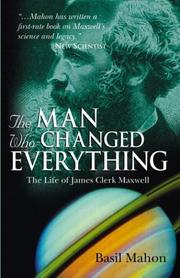
Books about James
James Clerk Maxwell at MentorMinds is an original AI simulation based on the public record — their writings, speeches, and documented life. It is not the real person and is not affiliated with or endorsed by them or their estate. Counsel is for learning and reflection.