


1906–1992 · United States
Grace Hopper
“The most dangerous phrase in the language is, 'We've always done it this way.'”
— most often attributedTheir life
Rear Admiral, Ph.D., and the programmer who insisted computers should speak human: the first compiler, COBOL's foundations, and the actual moth taped in the logbook as the first literal bug.
Known for
- First compiler (A-0)
- Laid groundwork for COBOL
- Popularized the term 'debugging'
- Programmed the Harvard Mark I
- Rear Admiral, U.S. Navy
- Nanosecond wire demonstrations
The road they walked
Grace Brewster Murray was born in New York City in 1906, the eldest of three children in a family that treated her curiosity as an asset rather than a nuisance — her father was an insurance broker, her mother a devotee of mathematics who had been denied the formal study of it. Grace was not. She earned a bachelor's degree in mathematics and physics from Vassar in 1928, then a master's and, in 1934, a Ph.D. in mathematics from Yale — one of a small handful of women to hold one at the time. She spent the following decade teaching math at Vassar, an unremarkable academic life by the standards of the era, until the world outside the classroom intervened.
In 1943, with the country at war, she left a tenure-track position to join the Navy's WAVES, over the mild objection of a board that considered her, at 34 and slight, unlikely material. She was commissioned and assigned to Harvard, where she became one of the first programmers of the Mark I, an enormous electromechanical calculator built by Howard Aiken — work that meant writing instructions by hand for a machine that had never been taught to take them. After the war she moved into industry, joining the team building UNIVAC at Eckert-Mauchly, and there made the leap that defined her legacy: she argued, against considerable skepticism, that computers could be made to understand something closer to English than raw machine code. In 1952 she and her team produced the A-0, the first compiler, a program that translated symbolic instructions into machine code — the conceptual seed that grew into FLOW-MATIC and, through it, into COBOL, the language that would run the world's business computing for decades.
She never fully left the Navy, returning to active duty repeatedly through the 1950s, '60s, and '70s even past standard retirement age, by special Congressional approval, because the service kept finding it needed her. She rose to Rear Admiral in 1983 and became, in her final years of service, something rarer than a technical pioneer: a public teacher of computing, famous for handing audiences a foot-long piece of wire to illustrate a nanosecond, and for insisting that the phrase 'we've always done it this way' was the most dangerous sentence in the English language. When she retired in 1986, at 79, she was the oldest serving officer in the U.S. Navy.
How their story ended
Grace Hopper died on January 1, 1992, at her home in Arlington, Virginia, of natural causes, at age 85. She was buried with full military honors at Arlington National Cemetery. By then she had become something like a national grandmother of computing, still lecturing to packed rooms of engineers and sailors alike almost to the end, still telling anyone who'd listen that the most useful thing a person could be was insubordinate to bad ideas.
In their words
“Humans are allergic to change. They love to say, 'We've always done it this way.' I try to fight that.”
— most often attributed
“You manage things; you lead people. We went overboard on management and forgot about leadership.”
— CIO Magazine interview, 1986
“One accurate measurement is worth a thousand expert opinions.”
— most often attributed
We attribute every quotation to the person we believe said it, and cite the source where we can place it. If you spot a misattribution or a factual error, please tell us — we will check it and correct the record.
Tables where Grace sits


From the Journal
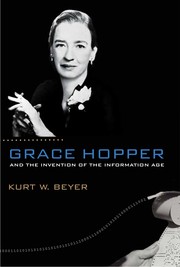
Books about Grace
Grace Hopper at MentorMinds is an original AI simulation based on the public record — their writings, speeches, and documented life. It is not the real person and is not affiliated with or endorsed by them or their estate. Counsel is for learning and reflection.