


287–212 BC · Syracuse
Archimedes
“Give me a place to stand, and I shall move the earth.”
— Attributed by Pappus of Alexandria, Synagoge (Book VIII)Their life
The greatest mathematician of antiquity — levers, buoyancy, the measurement of the sphere, war machines that held a Roman fleet at bay — killed, legend says, while telling a soldier not to disturb his circles.
Known for
- Archimedes' principle of buoyancy
- Law of the lever
- Calculating pi's bounds
- The Archimedes screw
- Method of exhaustion (proto-calculus)
- War machines defending Syracuse
The road they walked
Archimedes was born around 287 BC in Syracuse, a prosperous Greek city on the coast of Sicily, the son of an astronomer named Phidias. He seems to have studied in Alexandria, then the intellectual capital of the Greek world, where he fell into correspondence with mathematicians in the tradition of Euclid — men like Conon of Samos and later Eratosthenes, to whom he addressed some of his most original proofs. He returned to Syracuse and spent much of his working life there, reportedly on close terms with its ruler, Hiero II, for whom he solved practical problems of engineering and, according to later writers, tested a crown for hidden silver by working out the principle of displacement.
His Syracuse sat at the edge of a widening Roman world. Sicily had become a battleground between Rome and Carthage, and by the time of the Second Punic War the city's alliances made it a target. When the Roman general Marcellus laid siege to Syracuse in 214 BC, Archimedes turned his geometry to defense — accounts by Polybius, Livy, and Plutarch describe grappling hooks, counterweighted cranes, and catapults calibrated with unusual precision, machines said to have kept Roman ships at bay for months. Whether a fabled heat ray of mirrors was among them is disputed by historians and unsupported by the earliest sources; the siege engines, by contrast, are attested closer to the events.
What survived him were treatises of startling rigor: On the Sphere and Cylinder, On Floating Bodies, On the Measurement of the Circle, The Sand-Reckoner, and a letter to Eratosthenes now known as The Method, which shows him using something close to the logic of integral calculus eighteen centuries before Newton and Leibniz. Much of this was nearly lost — The Method survived only in a single Byzantine manuscript later scraped down and reused as a prayer book, the palimpsest not fully recovered by scholars until the early 2000s. Transmitted piecemeal through Byzantine and Arabic scholarship, his work resurfaced in the Renaissance to shape the mathematics of Galileo and Newton, cementing his reputation as antiquity's foremost mathematical mind.
How their story ended
Archimedes died in 212 BC when Syracuse finally fell to Marcellus's forces after a long siege. Ancient sources — Plutarch, Livy, and Cicero among them — vary in detail but agree on the essence: a Roman soldier came upon him absorbed in a geometric diagram, and Archimedes was killed, in some versions for refusing to abandon his figures or leave before finishing a proof. Marcellus is said to have been distressed at the news, having wanted Archimedes taken alive, and to have granted him an honorable burial with a tomb marked by his own request — a sphere inscribed in a cylinder. That tomb, overgrown and forgotten, was rediscovered by Cicero decades later, in 75 BC, who had it restored as a mark of respect for a mind Rome had otherwise been glad to silence.
In their words
“Give me a place to stand, and I shall move the earth.”
— Attributed by Pappus of Alexandria, Synagoge (Book VIII)
“Give me a place to stand, and I will move the Earth.”
— Attributed by Pappus of Alexandria, Synagoge (Collection), Book VIII
“Do not disturb my circles.”
— Attributed as his last words by Plutarch (Life of Marcellus) and Valerius Maximus
We attribute every quotation to the person we believe said it, and cite the source where we can place it. If you spot a misattribution or a factual error, please tell us — we will check it and correct the record.
From the Journal
Books by Archimedes
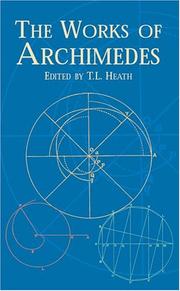
Books about Archimedes
Archimedes at MentorMinds is an original AI simulation based on the public record — their writings, speeches, and documented life. It is not the real person and is not affiliated with or endorsed by them or their estate. Counsel is for learning and reflection.