


1835–1919 · Scotland & United States
Andrew Carnegie
“The man who dies thus rich dies disgraced.”
— "Wealth", North American Review (1889)Their life
Bobbin boy at twelve, steel king at fifty, then the great giver: 2,500 libraries, universities, and pensions — driven by his own Gospel of Wealth, that a fortune is a trust to be administered for the community. His record includes Homestead's stain, and he knew it.
Known for
- Carnegie Steel and the Bessemer process
- Vertical integration of industry
- The Gospel of Wealth essay
- Over 2,500 public libraries funded
- Carnegie Hall and Carnegie Mellon University
- Homestead Strike of 1892
The road they walked
He was born in 1838—no, 1835—in Dunfermline, Scotland, the son of a handloom weaver whose trade was being erased by the power loom. That erasure mattered: it was the mechanization of his father's craft that pushed the Carnegies into poverty and, in 1848, onto a ship for America, where they settled among other Scottish emigrants in Allegheny, Pennsylvania. Andrew was thirteen. He went to work immediately in a cotton mill, tending bobbins twelve hours a day for a dollar twenty a week, and never forgot the smell of the oil and the ache of standing that long.
What lifted him out of the mill was not capital but attentiveness. He became a telegraph messenger boy, memorized the businesses of Pittsburgh by their addresses, taught himself to read Morse code by ear, and caught the notice of Thomas A. Scott of the Pennsylvania Railroad, who made him his personal telegraph operator and then his secretary. Scott also taught him to invest — a tip on Adams Express stock was Carnegie's first taste of capital income, and he chased that feeling into oil, bridges, and eventually iron. By the 1870s he had bet everything on steel, importing the Bessemer process from Britain and building an empire on vertical integration: owning the ore, the coke, the mills, the railroads that moved it all. Carnegie Steel became the largest steel producer in the world, and Carnegie himself, though frequently absent in Scotland, its public face and its philosopher.
In 1889 he published an essay called "Wealth," later retitled The Gospel of Wealth, arguing that a rich man who dies rich dies disgraced — that surplus fortune was a trust to be administered, in life, for the public good. It was a radical instruction to give himself. In 1901 he sold Carnegie Steel to J.P. Morgan for $480 million, becoming for a time the richest man alive, and spent his last eighteen years trying to give nearly all of it away — libraries, universities, pensions, peace foundations — a second career built entirely on unbuilding the first.
How their story ended
Andrew Carnegie died on August 11, 1919, at Shadow Brook, his estate in Lenox, Massachusetts, of bronchopneumonia. He was 83. By then he had given away some $350 million of his fortune — to libraries, universities, pensions, and peace institutions — and his will disposed of what remained, fulfilling to the last the creed he had set down decades earlier: that a fortune unspent for the public good was a fortune wasted.
In their words
“The way to become rich is to put all your eggs in one basket and then watch that basket.”
— "The Road to Business Success" speech (1885)
“There is no class so pitiably wretched as that which possesses money and nothing else.”
— The Gospel of Wealth (1889)
“The man who dies thus rich dies disgraced.”
— "Wealth", North American Review (1889)
We attribute every quotation to the person we believe said it, and cite the source where we can place it. If you spot a misattribution or a factual error, please tell us — we will check it and correct the record.
Tables where Andrew sits


From the Journal
Books by Andrew
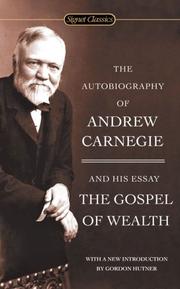

Books about Andrew
Andrew Carnegie at MentorMinds is an original AI simulation based on the public record — their writings, speeches, and documented life. It is not the real person and is not affiliated with or endorsed by them or their estate. Counsel is for learning and reflection.