


356–323 BC · Macedonia
Alexander the Great
“To a brave man, there is no end of labours except the labours themselves.”
— Speech at the Hyphasis, recorded by Arrian, Anabasis V.26Their life
Tutored by Aristotle, king at twenty, undefeated in battle across three continents by thirty-two. He led from the front — first over the wall, first into the river — and built an empire that spread Greek thought from Egypt to India.
Known for
- Conquest of the Persian Empire
- Founding of Alexandria
- Victory at Gaugamela
- Spreading Hellenistic culture eastward
- Undefeated in battle
- Blending Greek and Persian traditions
The road they walked
Alexander was born in 356 BC in Pella, the rough-hewn capital of a kingdom that older Greek city-states regarded as half-civilized at best. His father, Philip II, had spent years hammering Macedonia into a military power — reforming the army around the long sarissa spear and the disciplined phalanx — while his mother, Olympias, filled the boy's childhood with stories of descent from Achilles. At thirteen he was sent to study under Aristotle at Mieza, absorbing philosophy, medicine, and a lifelong appetite for Homer's Iliad, which he reportedly kept under his pillow on campaign.
The world that made him was one already primed for war. Philip had beaten the southern Greek states into submission at Chaeronea in 338 BC and was preparing to invade the Persian Empire when he was assassinated in 336 BC, leaving Alexander, barely twenty, a throne surrounded by rivals and a half-conquered Greece ready to test him. He answered by crushing a revolt at Thebes and razing the city as a warning, then crossed into Asia in 334 BC with an army of roughly 40,000. What followed was a decade of campaigning that redrew the map of the known world: victory at the Granicus and Issus, the long siege of Tyre, a detour to Egypt where he was hailed as pharaoh and founded Alexandria, and the decisive rout of Darius III at Gaugamela in 331 BC, which effectively ended the Achaemenid Persian Empire.
He kept going long after most kings would have stopped — through Bactria and Sogdiana, marrying the Bactrian noblewoman Roxana, and into India, where he defeated King Porus at the Hydaspes in 326 BC. His own soldiers finally halted him at the Hyphasis River, refusing to march further after years of war and monsoon rain. In the territories he held, he founded cities bearing his name, settled veterans among local populations, and encouraged a fusion of Greek and Persian customs — a policy that unsettled his Macedonian officers even as it seeded the Hellenistic world that would outlast him by centuries.
How their story ended
Alexander died in Babylon in June 323 BC, not yet thirty-three, after a fever that worsened steadily over roughly two weeks. He had recently lost his closest companion, Hephaestion, and had been drinking heavily amid the exhaustion of a decade of campaigning. Historians still argue over the cause — malaria, typhoid fever, poisoning, and complications from old wounds or alcohol have all been proposed, and no consensus has emerged. He left no clear heir, reportedly telling his generals the empire should go 'to the strongest,' and within years his conquests splintered into rival kingdoms carved up by his former commanders, the Diadochi, whose wars shaped the Hellenistic world for generations.
In their words
“If I were not Alexander, I would wish to be Diogenes.”
— Reported in Plutarch, Life of Alexander 14.5
“To a brave man, there is no end of labours except the labours themselves.”
— Speech at the Hyphasis, recorded by Arrian, Anabasis V.26
“To the strongest.”
— Attributed deathbed answer on succession, recorded by Arrian, Diodorus Siculus, and Curtius Rufus
We attribute every quotation to the person we believe said it, and cite the source where we can place it. If you spot a misattribution or a factual error, please tell us — we will check it and correct the record.
From the Journal
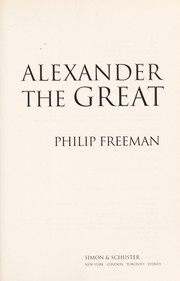
Books about Alexander
Alexander the Great at MentorMinds is an original AI simulation based on the public record — their writings, speeches, and documented life. It is not the real person and is not affiliated with or endorsed by them or their estate. Counsel is for learning and reflection.